
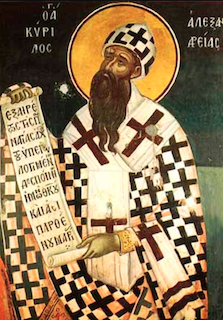
+ 4th century Father among the Saints
+ Third Ecumenical Council, the Council of Ephesus (AD 431)
+ 4th century Christology
Life
- https://orthodoxwiki.org/Cyril_of_Alexandria
- https://en.wikipedia.org/wiki/Cyril_of_Alexandria
- https://www.oca.org/saints/lives/2009/06/09/101595-saint-cyril-archbishop-of-alexandria
Teachings
- Unity of Christ: Cyril asserted the hypostatic union, the belief that Jesus Christ is one person in two natures, fully divine and fully human. This unity is inseparable and without confusion, ensuring that Christ’s humanity is not overshadowed by His divinity.
- Theotokos: He strongly advocated for the title of Theotokos (God-bearer or Mother of God) for the Virgin Mary, emphasizing that she gave birth to God in His incarnation as Jesus Christ. This title affirms the full divinity of Christ from the moment of His incarnation.
- Christ’s Salvific Role: Cyril underscored the significance of Christ’s incarnation, death, and resurrection for the salvation of humanity. He taught that through Christ’s unity of natures, humanity is enabled to partake in divinity, leading to redemption and deification (theosis).
- Eucharistic Theology: He contributed to the understanding of the Eucharist, affirming the real presence of Christ’s body and blood in the sacrament. Cyril saw the Eucharist as a means of participating in the life of Christ and a foretaste of the eschatological banquet.
- Scriptural Exegesis: Cyril was a prolific biblical commentator, advocating for an allegorical interpretation of Scripture. He believed that the Scriptures should be understood in a way that reveals the unified work of God in the history of salvation.
- Defense against Nestorianism: Cyril’s opposition to Nestorianism, which proposed a division between Christ’s divine and human natures, was a central aspect of his teaching. He argued that such a division undermines the reality of the incarnation and the efficacy of salvation.
- Importance of Church Unity: Throughout his work, Cyril emphasized the importance of unity within the Church, both in terms of doctrine and in the communion of believers. He saw the Church as the body of Christ, essential for the faithful to grow in holiness and truth.
Writings
- Commentaries on the Bible: Cyril wrote extensive commentaries on several books of the Bible, including the Pentateuch (the first five books of the Old Testament), Isaiah, the Minor Prophets, and the Gospel of John. His commentaries are notable for their allegorical interpretation and Christological focus.
- On the Unity of Christ: In this treatise, Cyril articulates his Christological views, emphasizing the unity of Christ’s divine and human natures in one person. This work is a key source for understanding Cyril’s argument against Nestorianism and the Third Ecumenical Council, the Council of Ephesus in AD 431.
- Thesaurus Against the Heretics: This is a systematic theological work aimed at refuting the arguments of Arianism and other heretical teachings. It provides a detailed exposition of orthodox Trinitarian doctrine and the nature of Christ.
- Letters: Cyril’s correspondence is of great historical and theological significance. His Third Letter to Nestorius is especially important, as it contains the twelve anathemas against Nestorius. Other letters were written to various bishops and ecclesiastical figures, discussing theological issues and church matters.
- Against Nestorius (Contra Nestorium): This work includes Cyril’s criticisms of Nestorius’s teachings. It is a comprehensive defense of the title Theotokos for Mary and a refutation of the division of Christ’s natures.
- Five Tomes Against Nestorius: These writings further detail Cyril’s arguments against Nestorianism, defending the unity of Christ’s person and the correct understanding of His natures.
- Homilies and Sermons: Cyril’s homilies and sermons provide insight into his pastoral concerns and his theological emphasis on the sacraments, the Virgin Mary, and the life of piety.
- Dialogue on the Trinity (Dialogues de Trinitate): Cyril also engaged in the Trinitarian debates of his time, defending the Nicene Creed and the doctrine of the Trinity against various heretical interpretations.
Troparion — Tone 1
With all reverence let us praise a light of the world, / the great orator and champion of the Mother of God. / For by his fiery teachings / he burned up the heresy of Nestorius; / therefore, let us cry out to him: / “Divine Cyril, intercede with Christ to strengthen the Orthodox Faith.”
Kontakion — Tone 6
You have openly poured out upon us the depth of the teachings of theology, / drawing from the well-springs of the Savior; / you drowned heresies / and saved your flock unharmed from triple waves. / Blessed and venerable Cyril, / you are shown to be a guide for all lands, revealing things divine
Feast Day(s)
June 9th
Sources:
- Saint Cyril of Alexandria: The Christological Controversy, by John McGuckin
- ChatGPT-4 (mining and summarization of historical data)
 Orthodoxy of the Heart